 Image 1 of 1
English Extension 1 Worlds of Upheaval: Annotated Band 6 Essay Resource
$30.00
A high-impact, classroom-ready resource that shows students not just what a sophisticated essay looks like, but how every sentence builds argument, integrates evidence, analyses form, and develops a powerful conceptual thesis.
Teaching Extension English 1 requires more than providing students with a strong exemplar. Students need to understand the architecture of sophisticated writing, how a thesis is built, how textual form shapes meaning, how context is integrated with purpose, and how evaluation is sustained across an entire response.
This Worlds of Upheaval annotated essay resource has been designed to make high-range writing visible, explicit and teachable.
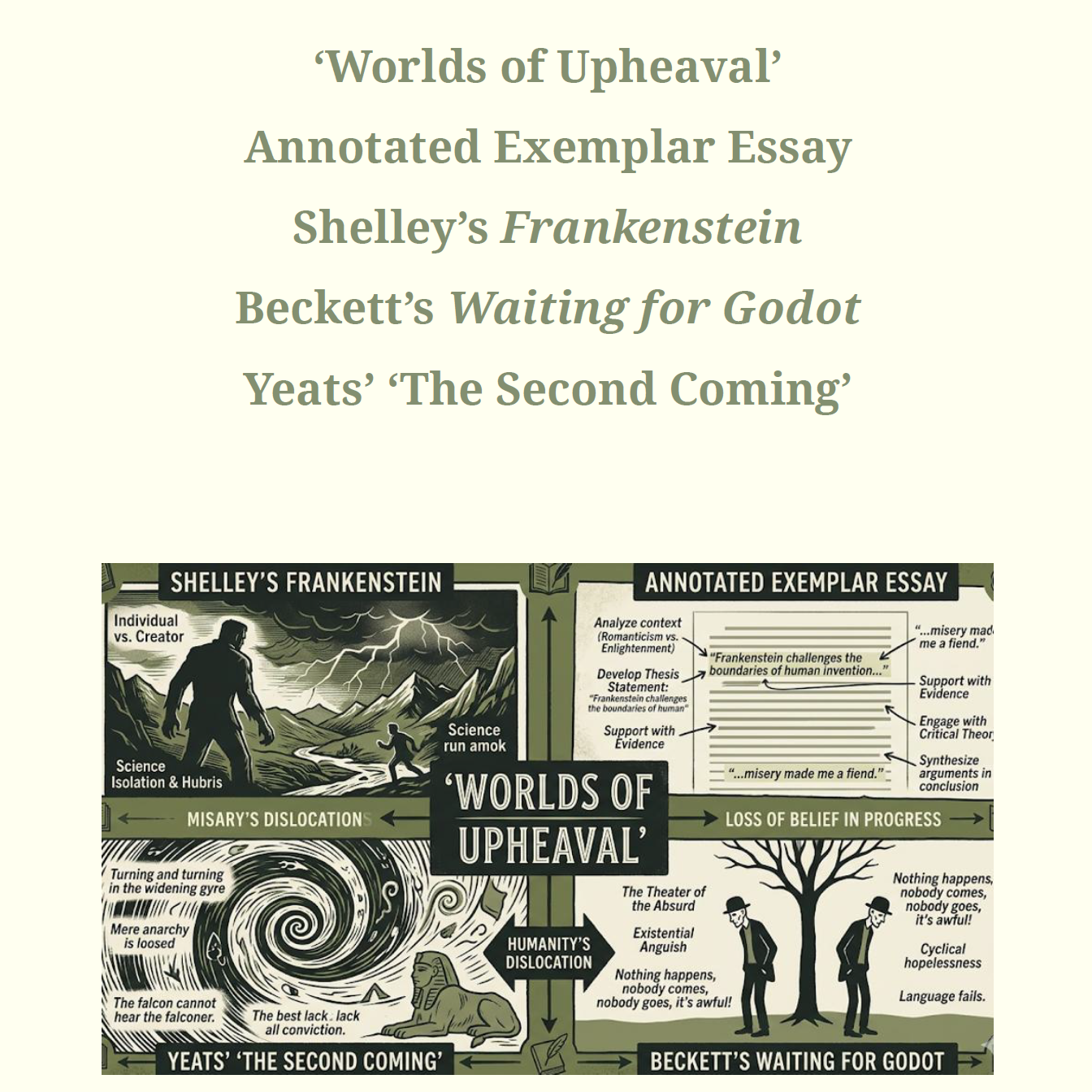
Centred on Mary Shelley’s Frankenstein, W.B. Yeats’ ‘The Second Coming’ and Samuel Beckett’s Waiting for Godot, this resource demonstrates how students can construct a complex, integrated thesis across three texts without falling into disconnected textual analysis or formulaic comparison.
This is not a generic essay, instead it is a writing resource that teaches students the craft of high-range analytical expression.
The annotations make visible the intellectual strategies that strong writers use such as, defining the conceptual field, positioning composers, embedding form, using context purposefully, moving from evidence to judgement, and sustaining a thesis across an entire response.
For teachers, this means the essay can be used flexibly as:
a modelled writing resource
a guided annotation activity
a close study of thesis development
a scaffold for unpacking introductions and conclusions
a resource for teaching integrated textual argument
a tool for improving student evaluations
a pre-assessment revision resource
a professional learning model for explicit analytical writing instruction
Teachers can use this resource to support students at multiple points in the learning sequence.
Use it to model how to:
write a conceptual introduction
develop a body paragraph through form, context and evaluation
integrate theorists without losing control of the argument
use evidence cumulatively rather than decoratively
write with clarity, precision and sophistication
move from textual analysis to module significance
craft a conclusion that synthesises rather than repeats
If your students can discuss the texts but struggle to turn their ideas into sophisticated writing, this resource gives them the sentence-by-sentence logic of an excellent response and gives them a clear map of how sophisticated writing works.
This resource helps students see how every sentence can develop argument, deepen evaluation and connect textual analysis to the big conceptual concerns of Worlds of Upheaval.
Perfect for Extension English teachers seeking a rigorous, ready-to-use resource that supports explicit teaching, close annotation and high-range analytical writing.
Support your students to move beyond strong ideas into powerful, precise and evaluative writing.
A high-impact, classroom-ready resource that shows students not just what a sophisticated essay looks like, but how every sentence builds argument, integrates evidence, analyses form, and develops a powerful conceptual thesis.
Teaching Extension English 1 requires more than providing students with a strong exemplar. Students need to understand the architecture of sophisticated writing, how a thesis is built, how textual form shapes meaning, how context is integrated with purpose, and how evaluation is sustained across an entire response.
This Worlds of Upheaval annotated essay resource has been designed to make high-range writing visible, explicit and teachable.
Centred on Mary Shelley’s Frankenstein, W.B. Yeats’ ‘The Second Coming’ and Samuel Beckett’s Waiting for Godot, this resource demonstrates how students can construct a complex, integrated thesis across three texts without falling into disconnected textual analysis or formulaic comparison.
This is not a generic essay, instead it is a writing resource that teaches students the craft of high-range analytical expression.
The annotations make visible the intellectual strategies that strong writers use such as, defining the conceptual field, positioning composers, embedding form, using context purposefully, moving from evidence to judgement, and sustaining a thesis across an entire response.
For teachers, this means the essay can be used flexibly as:
a modelled writing resource
a guided annotation activity
a close study of thesis development
a scaffold for unpacking introductions and conclusions
a resource for teaching integrated textual argument
a tool for improving student evaluations
a pre-assessment revision resource
a professional learning model for explicit analytical writing instruction
Teachers can use this resource to support students at multiple points in the learning sequence.
Use it to model how to:
write a conceptual introduction
develop a body paragraph through form, context and evaluation
integrate theorists without losing control of the argument
use evidence cumulatively rather than decoratively
write with clarity, precision and sophistication
move from textual analysis to module significance
craft a conclusion that synthesises rather than repeats
If your students can discuss the texts but struggle to turn their ideas into sophisticated writing, this resource gives them the sentence-by-sentence logic of an excellent response and gives them a clear map of how sophisticated writing works.
This resource helps students see how every sentence can develop argument, deepen evaluation and connect textual analysis to the big conceptual concerns of Worlds of Upheaval.
Perfect for Extension English teachers seeking a rigorous, ready-to-use resource that supports explicit teaching, close annotation and high-range analytical writing.
Support your students to move beyond strong ideas into powerful, precise and evaluative writing.