 Image 1 of 1
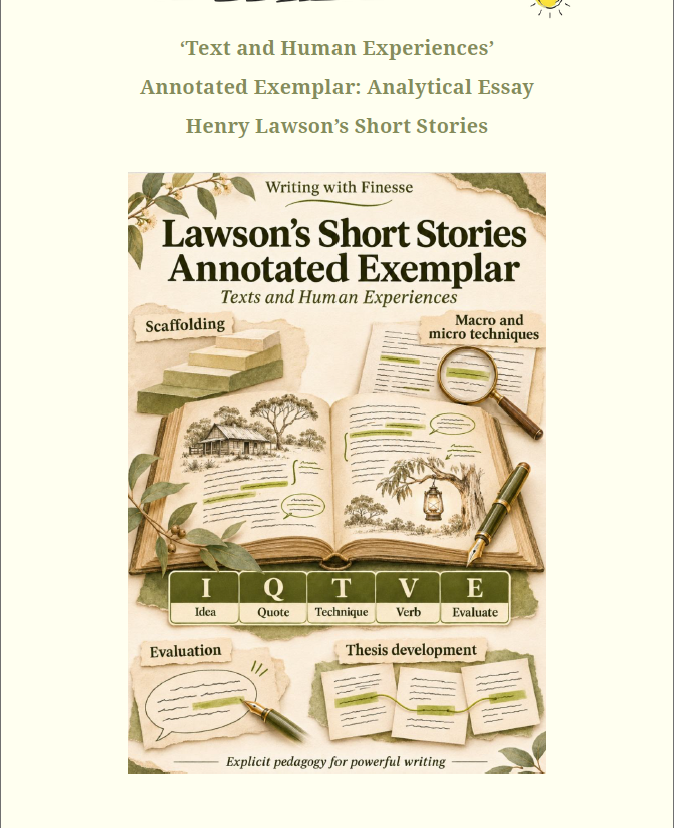
Annotated Exemplar: Texts and Human Experiences Henry Lawson's Short Stories
$30.00
Writing perceptively about Henry Lawson means examining the tensions beneath familiar ideals of courage, resilience and mateship. Students need to see how precise analysis of narrative voice develops into a sustained argument about human experience.
This Writing with Finesse annotated Band 6 exemplar offers a high-level model response to ‘The Drover’s Wife’, ‘Our Pipes’ and ‘The Union Buries Its Dead’, shaped through Texts and Human Experiences. Responding to a question about resilience and perseverance, it explores how Lawson’s restrained narration, reflective storytelling and anti-sentimental irony reveal the emotional demands of endurance and the importance of connection.
The resource deconstructs the writing sentence by sentence, making technical analysis, conceptual evaluation and thesis development visible. Detailed annotations show teachers and students how to:
respond precisely to an evaluative question
establish conceptual tension through Because–But–So
use IQTVE flexibly across connected sentences
analyse narrative voice, form and tonal variation
connect macro narrative choices with micro language features
integrate context into the argument
extend interpretation through further VE sentences
build purposeful connections between stories
develop a cumulative thesis across the complete response.
A particular strength is its explicit modelling of how an argument develops across three texts. ‘The Drover’s Wife’ establishes the courage and vulnerability of maternal endurance; ‘Our Pipes’ explores the companionship that sustains perseverance; and ‘The Union Buries Its Dead’ tests whether collective solidarity preserves genuine emotional responsiveness.
Students can see how each story extends or complicates the argument, developing a nuanced judgement about the relationship between survival, emotional restraint and responsibility for others.
At Writing with Finesse, we believe that thinking is writing. When students can follow how evidence supports an inference and how that inference advances a thesis, sophisticated analysis becomes something they can learn to construct.
For teachers developing students’ understanding of Lawson and their analytical confidence, this resource connects close reading, conceptual progression and purposeful composition through explicit, practical modelling.