 Image 1 of 1
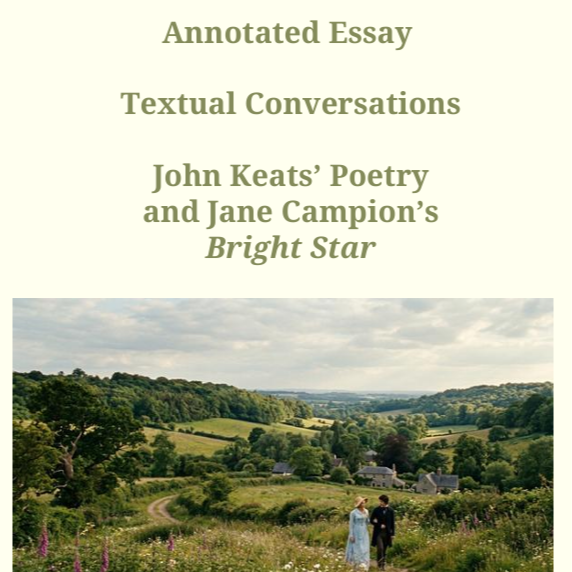
This annotated essay for the Module A pairing of John Keats and Bright Star offers a highly sophisticated exploration of textual conversation as a dynamic process of reinterpretation, where meaning is both affirmed and transformed across contexts.
Drawing explicitly on the elective’s focus on resonance and dissonance, this response models how students can construct a nuanced comparative argument that moves beyond identifying similarities and differences, instead evaluating how Jane Campion reimagines Keats’ Romantic concerns through a contemporary, feminist lens. The annotations unpack how Keats’ poetic abstractions particularly his exploration of love, mortality and artistic identity are reframed by Campion as lived, embodied experiences, foregrounding the shift from poetic idealisation to emotional and physical immediacy.
A particular strength of this model lies in its sustained integration of IQTVE to demonstrate how comparative analysis can be embedded within a cohesive line of argument. The resource explicitly guides students in developing a conceptual thesis, shaping paired analysis, and integrating contextual and theoretical perspectives, such as Romanticism, negative capability and feminist critique in purposeful and meaningful ways.
Importantly, this response positions textual conversation not as passive alignment, but as an active site of ideological negotiation. Through its exploration of Campion’s reclamation of Fanny Brawne’s voice and its interrogation of patriarchal literary traditions, the essay models how students can evaluate the ways later texts both challenge and extend earlier representations.
As a teaching tool, this annotated exemplar supports students in crafting perceptive, evaluative responses that demonstrate control over comparison, conceptual depth, and the ability to articulate how meaning evolves across time.
This annotated essay for the Module A pairing of John Keats and Bright Star offers a highly sophisticated exploration of textual conversation as a dynamic process of reinterpretation, where meaning is both affirmed and transformed across contexts.
Drawing explicitly on the elective’s focus on resonance and dissonance, this response models how students can construct a nuanced comparative argument that moves beyond identifying similarities and differences, instead evaluating how Jane Campion reimagines Keats’ Romantic concerns through a contemporary, feminist lens. The annotations unpack how Keats’ poetic abstractions particularly his exploration of love, mortality and artistic identity are reframed by Campion as lived, embodied experiences, foregrounding the shift from poetic idealisation to emotional and physical immediacy.
A particular strength of this model lies in its sustained integration of IQTVE to demonstrate how comparative analysis can be embedded within a cohesive line of argument. The resource explicitly guides students in developing a conceptual thesis, shaping paired analysis, and integrating contextual and theoretical perspectives, such as Romanticism, negative capability and feminist critique in purposeful and meaningful ways.
Importantly, this response positions textual conversation not as passive alignment, but as an active site of ideological negotiation. Through its exploration of Campion’s reclamation of Fanny Brawne’s voice and its interrogation of patriarchal literary traditions, the essay models how students can evaluate the ways later texts both challenge and extend earlier representations.
As a teaching tool, this annotated exemplar supports students in crafting perceptive, evaluative responses that demonstrate control over comparison, conceptual depth, and the ability to articulate how meaning evolves across time.